Tioman, Malaysia. Where it all began.
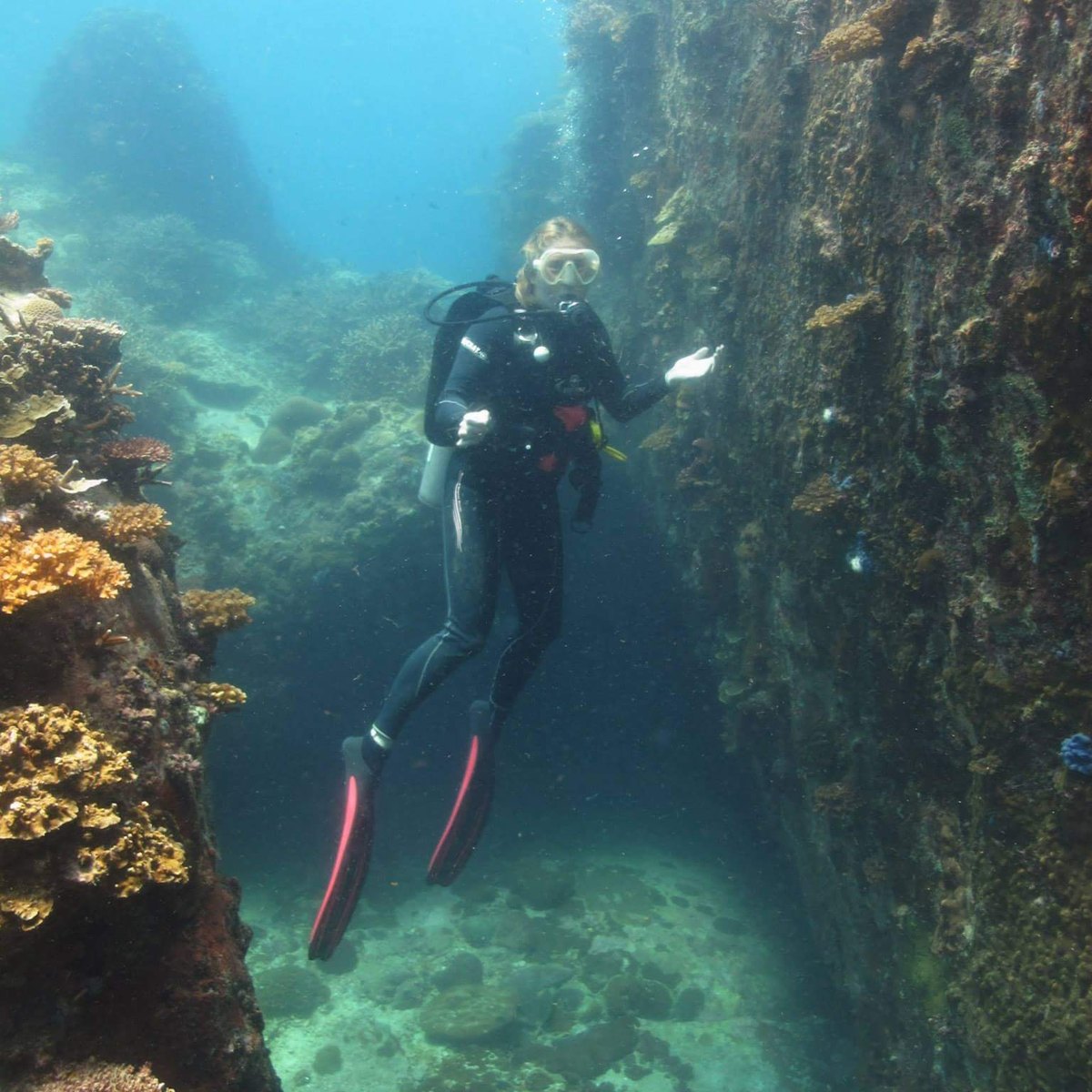
I was a young diver. Not yet an instructor, not yet in La Paz — just someone discovering the ocean floor with wide-open eyes. It was there, in Tioman, Malaysia, that I had my first revelation. I found something on a rock. And there it was: a small, magnificent blue creature with dots arranged in perfect circles on its back. A nudibranch. I stayed there watching this extraordinary little thing for several minutes. Great for working on your buoyancy! From that day on, I never dived again without looking for nudibranchs. And since becoming an instructor, I have turned this passion into a team sport: teaching people to see them. Because that's the thing about nudibranchs — they are everywhere, but they only reveal themselves to those who know how to look.
What is a nudibranch?
The word comes from Latin: nudus (naked) and branchia (gills). It's a shell-less mollusc — a sea slug, if we're being blunt — that decided discretion was overrated and life was too short to be beige. There are over 3,000 species worldwide. Some measure less than a centimetre, others can exceed twenty. All are carnivores. The Sea of Cortez is home to dozens of species, and new ones are regularly discovered. Every dive is a possible first.
What makes them so extraordinary
Colour as a weapon
Most nudibranchs are toxic or taste terrible. Their vivid colours warn predators: 'touch me and you'll regret it.' This is called aposematism — and it works, since nudibranchs have very few natural predators.
Some steal their prey's weapons
Aeolids eat anemones and collect their stinging cells without triggering them, storing them as a shield. Stealing your enemy's weapons and turning them against them — respect.
Some perform photosynthesis
In the Sea of Cortez, the Diomedes' sapsucker stores chloroplasts from the algae it eats and uses them for photosynthesis, like a plant. An animal that eats sunlight. Hard to get stranger than that.
They are hermaphrodites
Each nudibranch is simultaneously male and female. During mating, both partners exchange sperm with each other. Efficient, if probably confusing.
They live very briefly
Most species live only a few months — which makes every encounter all the more precious.
Species I love finding around La Paz
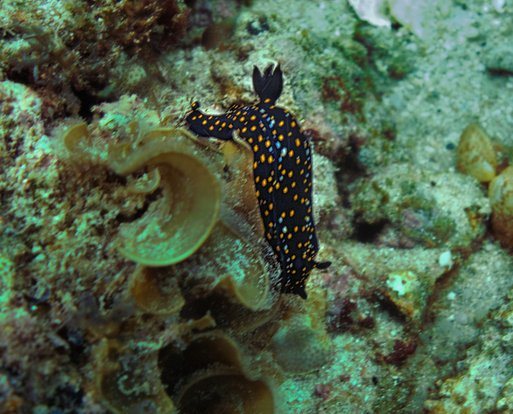
Dorid nudibranch
Hypselodoris ghiselini
"Gisele is my nickname"
Shiny black body dotted with small orange and white spots, dark feathery gills. I recognise this one from ten metres away. It has that slightly arrogant air of a creature that knows it's beautiful. Common on La Paz reefs between 5 and 25 metres, especially at Swanee.
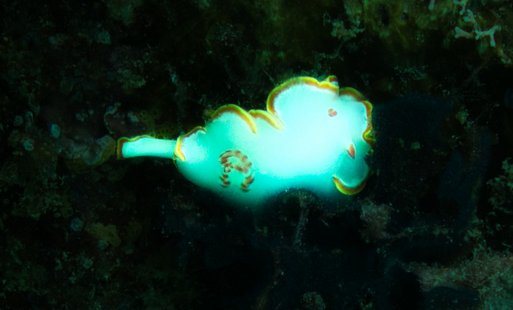
Dorid nudibranch
Glossodoris sedna
"You can call me Cutie"
A luminous white body, almost fluorescent, with bright orange edges. Characteristic of the tropical Eastern Pacific, it's a regular on our local dive sites.
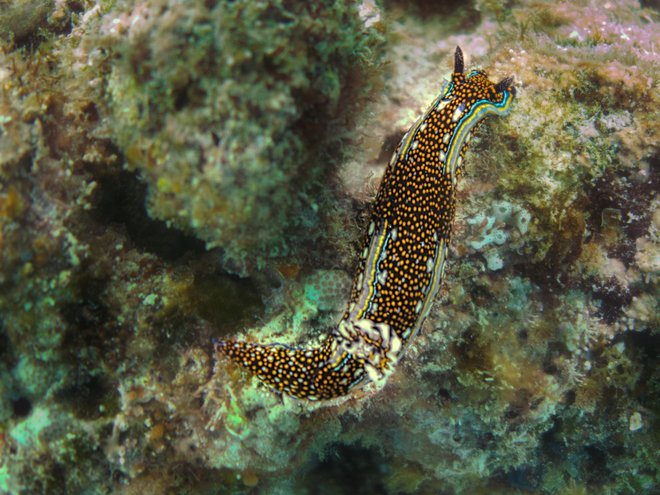
Agassiz's Chromodorid
Mexichromis agassizii
"Proud to be nudibranch"
Orange-brown body covered in luminous spots with a fine blue border. Elegant, discreet, and often found nibbling on an orange sponge — whose colour it has clearly adopted as its own. A nudibranch that literally wears its food.
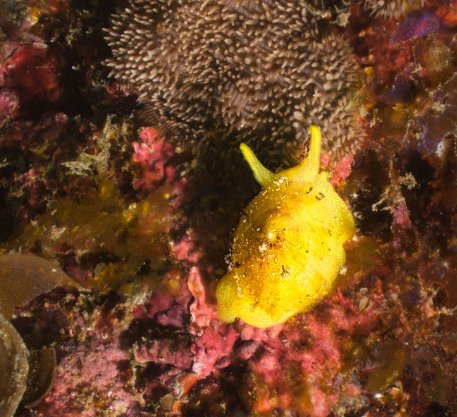
Mushroom Sidegill Snail
Tylodina fungina
"I am not just a snail"
Technically not a true nudibranch — it's an opisthobranch with a vestigial shell. But I mention it because it's bright yellow and easy to spot. It feeds on yellow sponges and seems to have decided to permanently wear the colour of its favourite meal.
Solar sea slug ✦
Elysia diomedea — The Mexican Dancer
"The one with lettuce on her back"
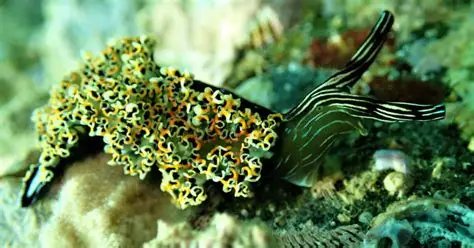
© mexicanmarinelife.org
Immediately recognisable: emerald green body bordered by wavy, ruffled folds, exactly like a lettuce leaf. Or like a flamenco dress — hence the nickname. What makes it truly extraordinary is its lifestyle: it feeds on algae but does not digest the chloroplasts — it stores them in those green folds and uses them for photosynthesis. A solar-powered sea slug. It literally eats sunlight. To make this work, it stays in shallow water where light penetrates well, making it easier to find — and it's the most common opisthobranch on the Mexican Pacific.
🌿 At Swanee, in winter and spring, Mexican Dancers literally invade the reef. Why there in particular? Probably a combination of ideal depth, abundant light and available algae. Magical.
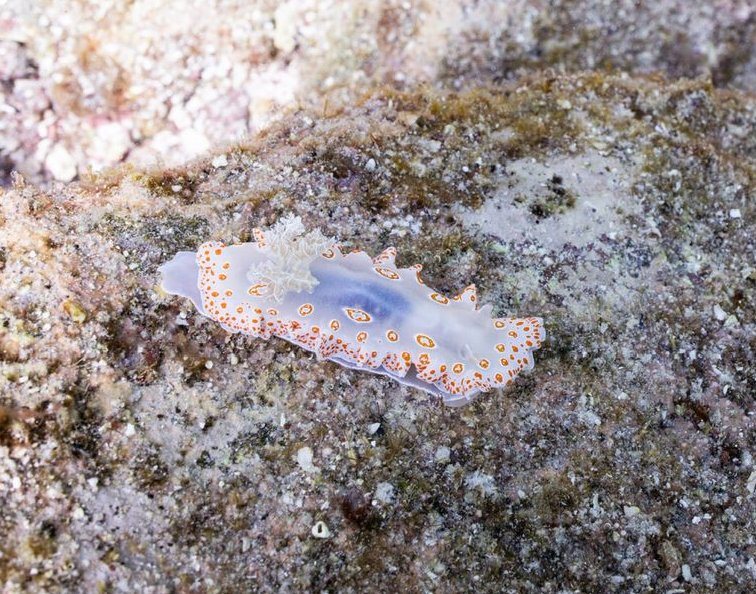
Translucent with orange spots
Nudibranch spotted by a client
"Species under identification"
Sent by one of my divers after our last dive — and that's exactly why I love my clients. Translucent body, almost invisible, with small orange dots arranged in circles. Some of these little treasures are not yet fully catalogued in the Sea of Cortez — every new observation counts. My new favourite!
The joy of showing
What I love almost as much as finding them is showing them. There is something unique in the look of a diver who sees their first nudibranch. At first they see nothing — I point, they look, they shrug underwater. Then suddenly it clicks. Their eyes go wide. And for the next ten minutes, the rest of the dive no longer exists. That's exactly what happened to me in Tioman. Over twenty years later, I'm still the first to stop at a rock to look for what the others haven't seen yet.
Want to find nudibranchs with us?
The Sea of Cortez is full of these little jewels — at Swanee Reef, the Fang Ming wreck, Los Islotes, and in the most unexpected corners. You just need to know how to look. And that's exactly what I can teach you.
Book your dive → WhatsApp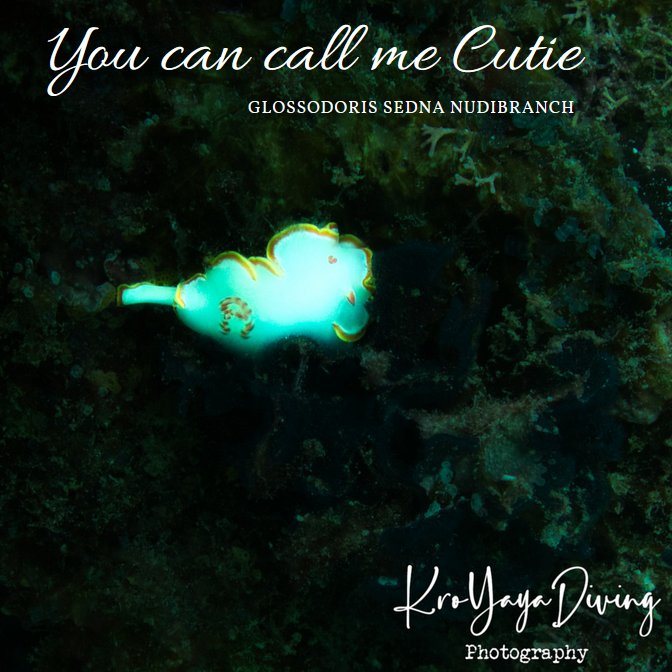
Carolina
PADI MSDT · Dive With Us BCS
6,000+ dives across five oceans. Nudibranch hunter since Tioman, 2004. PADI MSDT instructor. TripAdvisor Travelers' Choice Award 2026.